 Smarties Press
Introduction to the Theory of Programming Languages Beyond programming. Understand the theory.
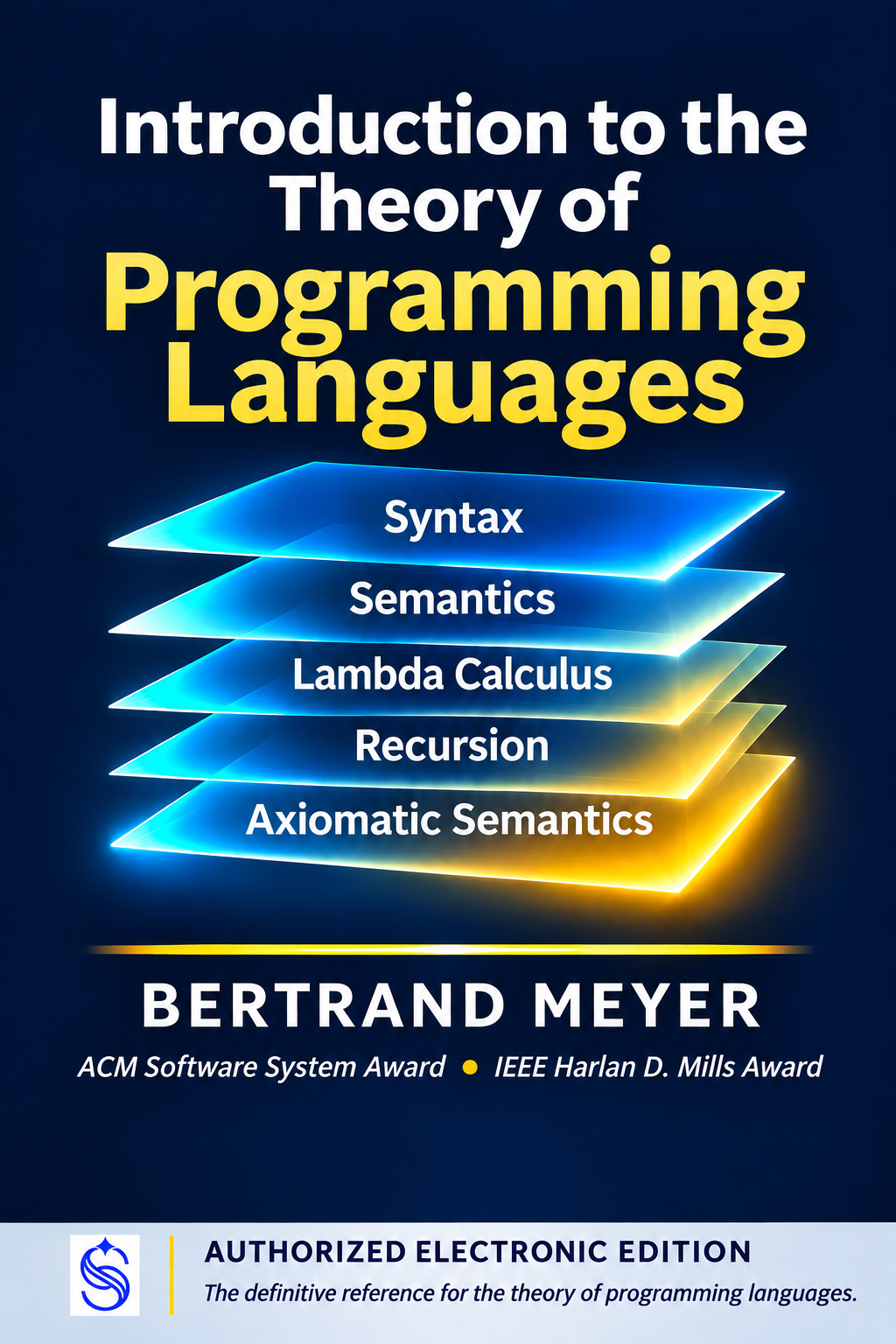
What are the fundamental ideas that make programming languages work? Programming languages are built on deep mathematical and theoretical foundations. Beyond syntax, they rely on formal models of computation, precise semantic definitions, and principles that explain how programs behave. Introduction to the Theory of Programming Languages explores these foundations, guiding readers from the basics of language structure to the mathematical theories that underpin modern programming. Explore the Foundations Discover the essential concepts of programming language theory: • Syntax: Formal rules that define the structure of programming languages. • Semantics: Approaches for describing and understanding program meaning. • Lambda Calculus: A foundational mathematical model of computation and functional programming. • Denotational Semantics: Methods for expressing language meaning through mathematics. • Recursion: The theory behind self-referential definitions and computation. • Axiomatic Semantics: Formal techniques for reasoning about program correctness. From Fundamentals to Formal Theory The book begins with core mathematical concepts and language structure before introducing major semantic frameworks. It then explores lambda calculus, denotational semantics, recursion theory, axiomatic semantics, and related approaches to defining and understanding programming languages. Who Is This Book For? This book is designed for students, educators, researchers, and software professionals who want a deeper understanding of the theoretical foundations of programming languages and computation.Understand the language. Understand the theory. Understand computation. Go beyond programming and discover the foundations that make it possible
Explore the Table of Contents
Each chapter includes practical guidance you can apply immediately.